Interlining Explained: Fusible vs Sew-in, Resins and Fusing

Interlining is the only component in a garment that a customer never sees and always notices. It decides whether a collar holds its shape after ten washes, whether a placket lies flat, and whether a jacket front collapses after a season.
It is also the component most often specified by habit — “the same as last season” — and then blamed when something goes wrong. This guide sets out how the three base constructions behave, what the resin systems actually differ in, why the coating method matters more than most buyers realise, and the four failure modes that account for nearly every production problem in this category.
How to read the figures in this guide
Standard – the wash and dry-clean test methods named later are published ISO standards you can cite in a contract. Convention – resin activation temperatures, fusing parameters and weight selections are typical industry ranges rather than standardised values, and they vary by resin formulation, base fabric and press type. Verify required – every fusing parameter in this guide must be confirmed by a trial on the actual shell fabric and the actual press before production.
Three tiers of confidence:
- Standard — a published test method you can name on a purchase order.
- Convention — typical industry ranges. Useful as a starting point, not as a guarantee.
- Verify required — must be confirmed by trial on your own fabric, press and production speed.
What interlining is for
Interlining is a functional layer placed between the shell fabric and the lining, or bonded to the back of the shell. It is applied to areas rather than to whole garments — collars, cuffs, plackets, pocket openings, waistbands, facings, lapels and jacket fronts.
It does four jobs: it adds stability so a part does not stretch during sewing or wearing; it adds body so a shape reads as intended; it reinforces stress points; and it controls how a fabric behaves at the edge. It is not the same thing as lining, which covers a whole interior surface.
Fusible versus sew-in
Fusible interlining carries a thermoplastic resin that melts under heat and pressure and bonds to the shell. Sew-in interlining is stitched in place. Fusible dominates modern production because it is fast, consistent and cheap to apply; sew-in survives where heat or adhesive would cause a problem.
| Aspect | Fusible | Sew-in |
|---|---|---|
| Attachment | Heat and pressure in a press | Stitched into the seam allowance |
| Speed | Seconds per panel | Substantially slower — needs a separate operation |
| Consistency | High once parameters are set | Depends on operator skill |
| Equipment | Fusing press, calibrated | Standard sewing only |
| Hand feel | Can stiffen the shell; a risk on delicate fabric | Softer, more flexible; can be shaped over a canvas |
| Wash and dry-clean durability | Depends on the resin; peel strength falls with washing | No adhesive to degrade |
| Where it is required | Shirt collars, cuffs, plackets, facings, most volume production | Flame-resistant protective clothing, heat-sensitive shells, tailored canvas work |
The decisive case for sew-in is flame resistance. In protective clothing for firefighting, metal fabrication and similar environments, a heat-bonded resin may not survive service conditions, and sew-in remains the standard route. It is also the answer when the shell fabric cannot take the fusing temperature without marking or shrinking.
Base construction: woven, knitted and non-woven
| Base | Structure | Behaviour | Typical use | Watch out for |
|---|---|---|---|---|
| Woven | Interlaced warp and weft | Stable, strong, holds shape; little or no stretch except on the bias | Shirt collars and cuffs, tailored jacket fronts, waistbands, coat fronts | Grain direction matters — cut on the wrong grain and the part twists |
| Knitted | Interlooped yarns, often weft-inserted warp knit | Soft, elastic, recovers with the shell | Knit garments, stretch suiting, jersey, activewear | Costs more than non-woven; must match the stretch of the shell |
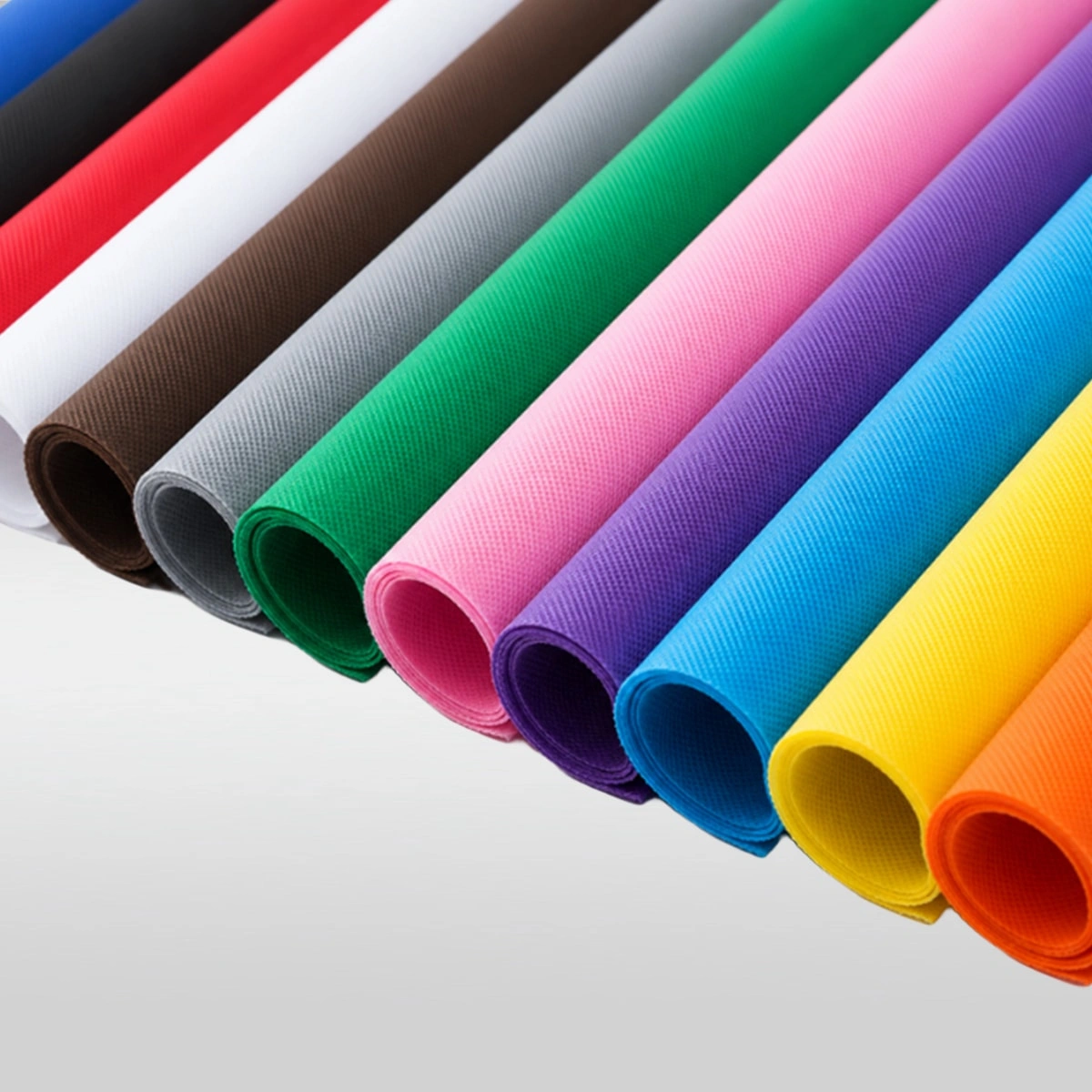
| Non-woven | Fibres bonded directly, no yarn stage | Isotropic — no grainline; light and economical; does not fray | Blouses, pocket facings, plackets, light commercial garments | Generally less durable through repeated laundering; can migrate fibre through a light shell |
Non-woven is the largest category by volume in apparel and the cheapest. Woven remains the benchmark wherever shape retention is the point. Knitted is the specialist answer for stretch, and it is the only one of the three that will follow a shell containing elastane without fighting it.
Weight selection
Non-woven interlinings span roughly 10 gsm to over 200 gsm, covering everything from a light blouse facing to a heavy coat front. The rule is to match the interlining to the shell, not to the desired stiffness: an interlining heavier than the shell will dominate it, and the result reads as cheap rather than as structured.
Bias-cut and weft-inserted tapes are a separate category. They are narrow, and they are used to prevent stretch in a specific direction — armholes, pocket edges, lapel roll lines — rather than to add body.
Resin systems
The resin decides what the bond can survive: dry cleaning, industrial laundering, or neither. Activation temperatures below are typical ranges and vary by formulation, so they are a starting point for a trial rather than a setting.
| Resin | Typical activation | Character | Best for |
|---|---|---|---|
| Polyamide (PA) | About 120–160 °C | Soft hand, good dry-clean resistance, versatile | Tailored outerwear, wool, dry-clean-only garments |
| Polyester (PES) | About 130–150 °C | Good wash resistance and steam-press stability | Washable shirts, casual trousers, rainwear |
| Polyethylene (PE) | About 110–130 °C | Firm bond, strong wash resistance | Shirt collars and cuffs destined for industrial laundering |
| Polypropylene (PP) | About 100–120 °C | Low-temperature bonding | Heat-sensitive synthetic shells |
Choose the resin from the garment’s end use, not from habit. A shirt collar that will go through industrial laundry needs a resin that survives it; a dry-clean-only jacket needs one that survives solvent. Getting this backwards is the most common cause of delamination complaints months after delivery.
Coating method: the specification that gets skipped
The resin is applied to the base in one of several patterns, and the method changes how the bond behaves at least as much as the resin chemistry does.
- Scatter coating — powdered resin distributed randomly. Adequate for many non-woven applications; lower cost.
- Dot coating — regular dots, typically fractions of a millimetre across, at a controlled density per square centimetre. Preserves hand and drape because only part of the surface is bonded.
- Paste coating — a continuous film. Maximum bond strength, and the stiffest result. Used for heavy-duty applications.
- Double-dot coating — a base layer that seals the interlining and prevents resin migrating through it, with an upper adhesive dot above it that does the bonding. This is the premium route and the standard answer to strike-through on difficult shells.
Ask which method is being quoted. Two interlinings with the same base weight and the same resin can behave quite differently under the press purely because of the coating.
Matching interlining to the garment area
| Area | What it needs | Interlining commonly used |
|---|---|---|
| Formal shirt collar, stand and cuff | Stiffness, a flat unpuckered surface, shrinkage control | Stable woven, often cotton-based, fusible |
| Casual shirt collar and placket | Softer hand; a washed or slightly puckered look may be wanted | Woven fusible, or non-woven where a softer result is acceptable |
| Jacket front | Shape, fit and drape | Bi-elastic woven fusible; canvas construction in tailored work |
| Jacket lapel, hem and pocket edges | Crisp edges, shape retention | Weft-inserted non-woven tape |
| Jacket armhole | Stretch control during sewing and wear | Non-woven fusible tape, cut on the bias |
| Trouser or skirt waistband | Stabilisation and a clean edge | Woven fusible cut on the bias, or a lightweight bi-elastic |
| Neckline and hem facings | Shape retention and stretch control | Woven or non-woven fusible, matched to the shell weight |
| Pocket opening | Local stabilisation | Small non-woven fusible patch or tape |
| Protective and flame-resistant clothing | Flame retardancy through the whole assembly | Flame-retardant interlining, normally sewn in rather than fused |
A single jacket will routinely carry three or more different interlinings, selected by position and function rather than by one specification for the whole garment. That is normal, and a quotation that offers one product for every area is worth questioning.
The fusing triad: temperature, pressure and time
Fusing has three variables and they interact. Getting two right and one wrong produces a panel that looks fine on the day and fails in service.
- Temperature — set from the resin, not from the shell. Too low and the resin never fully melts, so the bond is weak from the start. Too high and the resin becomes too fluid and migrates.
- Pressure — drives molten resin into the shell surface. Uneven pressure across a press produces panels that bond in the middle and fail at the edges.
- Dwell time — typically in the range of ten to twenty seconds per panel, and dependent on the press, the fabric and the resin. Too short leaves the resin unmelted; too long drives it through.
Always run a trial on the production press, not on a sample press. Continuous rotary presses and flat-bed presses do not transfer parameters one-to-one.
The four failure modes
Almost every interlining complaint is one of these:
| Failure | What you see | Usual cause |
|---|---|---|
| Strike-through | Resin appears on the face of the shell as shiny or discoloured spots | Too much heat, too long a dwell, resin too fluid, or a coating method unsuited to an open or lightweight shell |
| Strike-back | Resin appears on the back of the interlining and contaminates the press belt | Excess resin, excessive pressure, or a base fabric that does not hold the resin |
| Bubbling / delamination | The interlining separates from the shell in patches, often after washing | Under-fusing — resin never fully melted — or a resin that cannot survive the garment care regime |
| Boardy hand | The fused panel is stiffer than intended and the garment loses its drape | Interlining too heavy for the shell, or a paste coating where a dot coating was needed |
The diagnostic value here is that the failure usually points back to a parameter rather than to a bad material. Before changing supplier, check temperature, pressure, dwell time and coating method against the shell fabric actually being used.
Testing and standards
The properties worth specifying, and the methods normally used to check them:
- Peel bond strength — fused strips pulled apart, commonly at 180 degrees, on a tensile tester. This is the number that predicts delamination, and it should be measured after washing or dry-cleaning, not only before.
- Dimensional stability — how the fused composite moves in washing. The relevant domestic laundering procedure is the ISO 6330 series.
- Dry-cleaning resistance — the ISO 3175 series covers cleaning in perchloroethylene and other solvents.
- Appearance after cleaning — assessed alongside the shell, because a bond can survive while the surface puckers.
- Colour fastness — the ISO 105 series, as for any textile component.
Confirm the current version and scope of each standard before citing it in a contract; this guide names the series normally used and is not a substitute for the published documents.
Buyer checklist
Write these into the specification:
- Base construction — woven, knitted or non-woven, and the fibre.
- Weight in gsm, matched to the shell rather than to a preferred stiffness.
- Resin type, selected from the garment’s care regime.
- Coating method — scatter, dot, paste or double-dot, with dot density if it matters.
- Fusing parameters — temperature, pressure and dwell time, established by trial and recorded.
- Peel strength requirement, stated as a minimum after the relevant washing or dry-cleaning cycle.
- Shrinkage of the composite, not just of the interlining.
- Cut direction — straight, bias, or a weft-inserted tape.
- Shell fabric reference — the interlining is specified against a specific shell, and a change of shell invalidates the trial.
- Retained sample — one fused panel per lot, with the parameters it was fused at.
Frequently asked questions
What is the difference between interfacing and interlining?
The terms are used loosely and often interchangeably. In trade usage, interfacing usually refers to the piece a sewer buys and applies to a specific area, while interlining is the broader category including the structural layers used in tailoring — canvas, chest pieces, sleeve heads and wadding. Both sit between the shell and the lining or against the back of the shell.
Is fusible always better than sew-in?
No. Fusible dominates because it is fast and consistent, but sew-in is the standard route for flame-resistant protective clothing, for shells that cannot take the fusing temperature, and for tailored canvas work where the shape is built rather than bonded.
Why does my fused collar go bubbly after washing?
Usually under-fusing or the wrong resin. If the resin never fully melted during fusing, the bond was weak from the start and washing finishes it off. If the garment is washed industrially and the resin was chosen for dry cleaning, the same thing happens. Check the peel strength after the intended care cycle, not before.
What causes shiny marks on the face of the fabric?
Strike-through — resin migrating through the shell. The usual causes are excessive temperature, too long a dwell time, excess pressure, or a coating method not suited to a lightweight or open-weave shell. A double-dot coated interlining is the standard remedy.
Can I use one interlining for a whole jacket?
Not if you want the usual result. A jacket typically uses several: a bi-elastic woven for the front, tapes for lapel and hem edges and armholes, and a chest construction in tailored work. One product for every area means every area is compromised.
Does grain direction matter on interlining?
Yes, on woven interlining — it has a warp and a weft, and cutting on the wrong grain will make a part twist. Non-woven has no grainline, which is one of its practical advantages. Several applications, such as waistbands, are cut on the bias deliberately, to control stretch in a chosen direction.
Resin activation temperatures, fusing parameters and weight selections in this guide are typical industry ranges, not standardised values. Confirm every parameter by a trial on the actual shell fabric, the actual resin and the production press, and confirm the current version of any standard before citing it in a contract.
Browse our range: Interfacing · Curtain Fabric · Tailoring Tools · Webbing & Tape
Share This Article
Follow Us
Blog Categories
Latest Articles

October 2, 2026
October 2, 2026
October 2, 2026